Half of all U.S. states have fully legalized marijuana and there are only six states where it is fully illegal — Kansas, Idaho, Nebraska, Wyoming, North Carolina and South Carolina (though cannabis is decriminalized in North Carolina and Nebraska).
It’s a cultural shift that has been decades in the making.
California became the first state to experiment with legal cannabis when it made medicinal marijuana legal in 1996. Maine, Hawaii, Nevada and Colorado followed suit over the next five years, allowing their citizens to also purchase medical cannabis.
The U.S. government gives the Drug Enforcement agency over $3 billion a year to fight its war on drugs, so a state openly defying the government’s edict against the plant was extremely radical at the time.
But between then and now, there was nearly two decades on no movement on the issue as the United States’ archaic federal laws against the growth and distribution of cannabis held firm.
But then in 2014 Colorado and Washington took it a step further than California did and became the first states in the union to legalize the recreational use and sale of marijuana.
That year, about 22.2 million Americans aged 12 or older reported current cannabis use, according to a national survey.
It turned out those two states legalizing recreational use represented the start of a newly energized cannabis movement in the United States. Since then, nearly two dozen states have also legalized recreational marijuana.
Washington and Colorado set the example
More than two-thirds of Americans polled by Gallup support legalizing marijuana. The 70% rate of support reached a record-high in October this year. Gallup has been issuing that cannabis poll since 1969.
Back then, just 12% of Americans admitted supporting the legalization of weed.
Gallup’s poll results also show the influence Colorado and Washington’s move to end prohibition in their states in 2014 helped spur the rapid adoption by the next 23 states.
While public support for cannabis legalization crossed the 50% mark for the first time in 2013, jumping up to 58% from 48% in 2012, it fell back down to 51% in 2014.
But since that year, support for legalizing marijuana has ballooned to the levels seen today.
“Although some health organizations and political commentators have raised concerns about the medical risks of marijuana, this hasn’t blunted the public’s desire for legalization thus far,” Gallup said.
“For now, the high level of support among younger adults suggests national backing will only expand in the years ahead, likely resulting in more states, and perhaps the federal government, moving to legalize it.”
Money is a major issue
If you think cannabis legislation moves slowly only at the federal level, you’d be wrong.
It took Hawaii, for instance, 20 years to graduate from legalizing medical marijuana — it was the first state to do so through a state legislature vote — to decriminalizing use of the plant in 2019.
While the journey has been long, the real inflection points for legalization came during the pandemic.
Shutting down the economy for over two years exposed and stressed many of the cracks in local economies that had been able to be hidden previously, and the money from taxes on cannabis (along with gambling) suddenly became more palatable for politicians who objected to legalization on moral grounds (see: John Boehner for reference).
Since 2020, Vermont, Arizona, Montana, New Jersey, South Dakota (later reversed by a circuit court judge) New York, Virginia, New Mexico, Connecticut, Rhode Island, Maryland, Missouri, Delaware, Minnesota, and Ohio have all legalized recreational marijuana.
Alabama, South Dakota, Mississippi (reversed by the Supreme Court of Mississippi) and Kentucky have legalized medical cannabis since then while Louisiana decriminalized the drug.
Maryland launched its adult-use cannabis industry in July this year and is seeing sales of $89.5 million a month. Thanks to the state’s 9% excise tax on adult use cannabis sales, the state has also received tens of millions of tax dollars it did not have access to last year.
So the economic case for legalizing cannabis is apparent for the states that are now participating. But for the rest of the country, it may take the federal government changing its laws in order for them to get on the cannabis train.
#IntheWeedswithSteve
Be patient Florida, this too, shall pass! Steven M Smith InspirationalTech.org CEO since 2013.
Illinois’ adult-use cannabis retailers reached a historic high in November, setting a record for the most legal cannabis sold primarily to in-state residents in a single month. Overall sales, including purchases made by out-of-state customers, ranked fifth-highest monthly total since weed shops opened in January 2020.
Breakdown of November’s Cannabis Sales
The Illinois Department of Financial and Professional Regulation reported total recreational cannabis sales amounting to $139.1 million for the month. According to Marijuana Moment, this figure includes $105.5 million in sales to Illinois residents and $33.6 million by visitors, exclusive of taxes.
Moreover, state-licensed retailers sold more individual adult-use cannabis products in November than ever before, with a total of 3.77 million items.
Medical Cannabis Sales and Market Trends
While the latest figures for medical cannabis sales in November are still pending, October’s sales reached $26.2 million, including $12.4 million in dry flower and $13.8 million in concentrates and infused products. This data comes from the Medical Cannabis Patient Program.
Despite these impressive numbers, Illinois consumers are facing higher cannabis prices compared to many other states with legal markets. Governor J.B. Pritzker acknowledged the high prices but emphasized the industry’s consistent expansion and the substantial sales to out-of-state customers.
2023: A Year Of Record-Breaking Growth
State officials also highlighted the “unprecedented” surge of state-legal cannabis sales in fiscal year 2023. This growth is partly attributed to the opening of 28 new retailers and total retail sales surpassing $1.5 billion.
The fiscal year 2023 brought approximately $451.9 million in revenue from legal cannabis to Illinois, outperforming alcohol revenue, which was around $316.3 million.
Advancing Social Equity in Cannabis Licensing
To address the impact of the War on Drugs, Illinois issued 200 conditional licenses and established a Social Equity Criteria Lottery. This initiative aims to prioritize individuals disproportionately affected by drug laws, with over 2,600 applicants for 55 new social equity dispensary licenses. Most of these new licenses were allocated in Cook County, the state’s most populous region.
A Boost to Diversity and Challenges for Small Growers
The industry has also seen a notable increase in minority and women-owned businesses since 2020. Black-owned companies now account for 27% of the market, Latino/a or Hispanic-owned companies for 5%, Asian-owned companies for 3%, and women-owned businesses make up 16%.
However, small cannabis growers are facing challenges, struggling to thrive even with state aid.
#IntheWeedswithSteve
Be patient Florida, this too, shall pass! Steven M Smith InspirationalTech.org CEO since 2013.
Thank you for consideration.
Sen. John Fetterman (D-PA), one of the most vociferous cannabis supporters among U.S. senators, recently said he was honored to vote for the SAFER Banking Act.
Commenting on recent Ohio’s cannabis legalization, Fetterman told City & State in an exclusive interview that “it’s absolutely absurd – how many states around Pennsylvania are we failing behind?”
“It just makes it more silly. It’s just so simple and so easy – just give people what they want,” he said. “And again, make it safe, make it pure and make jobs. All the benefits are going to the cartels, but now, it should be going to the state.”
Fetterman said though he doesn’t consume cannabis he believes sales should be allowed and taxed, just like alcohol. “I don’t remember the last time I even drank hard alcohol, but you should be able to buy it because we all realize what bathtub gin does to people. There are things that are so much more lethal and dangerous and addictive – you don’t have any of those issues with cannabis.”
The senator undertook expungement of minor drug charges, saying no one’s life should be ruined “because they had some stupid, silly weed charge.” As lieutenant governor and head of the pardoning process, “we got that process started. It’s always astonishing when you have people in front of you who can’t be a volunteer at their child’s school, can’t get a better job, can’t get a loan because 12 years ago they got caught with a joint.”
Fetterman said that because cannabis is illegal its value is distorted and is often the cause of violence and robberies.
No-Brainer
“There’s no medically documented THC overdose, and marijuana is not lethal at all. It’s a no-brainer,” he said.
He called President Joe Biden a man of his word because, on the first anniversary, he recommended marijuana de-scheduling. Furthermore, he added that it’s “always Republicans going against something that should be common sense and that a majority of people really want, whether it’s abortion or weed,” and that legalization is inevitable.
#IntheWeedswithSteve
Be patient Florida, this too, shall pass! Steven M Smith InspirationalTech.org CEO since 2013.
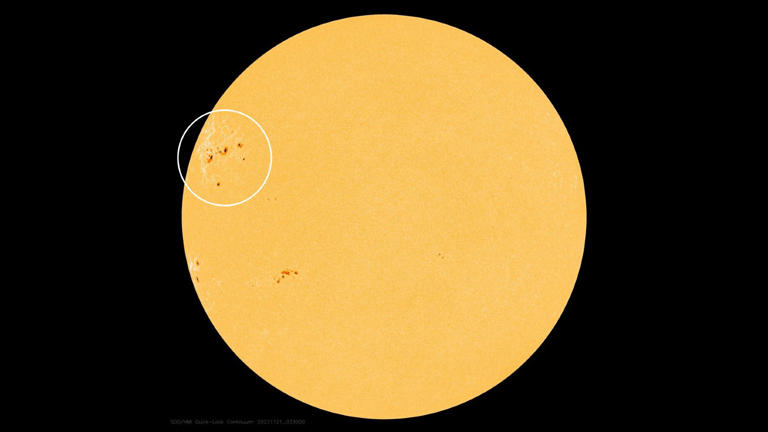
The sun has suddenly become much more active, bursting with sunspots and sending plumes of hot plasma out into space.
In the last week alone, sunspot numbers have increased by 10 times, dotting the sun’s surface with black pockmarks spewing out several coronal mass ejections every day.
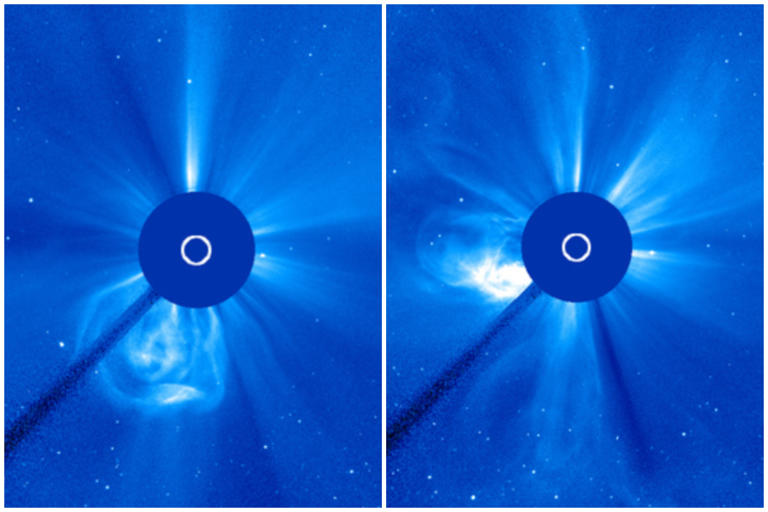
One of these coronal mass ejections (CMEs) may be due to hit the Earth in the coming days, a NASA model has shown, with one possibly due to collide with our magnetic field and atmosphere late on November 25. This will be confirmed after scientists fully analyze the trajectories of the storms.
Coronal mass ejections are huge clouds of solar plasma that are spat out of the sun in regions of high magnetic activity, which can include sunspots. The sun may also send out solar flares, which are bright bursts of electromagnetic energy.
“Solar flares and CME are both caused by the sun through its magnetic field being twisted and stressed through motions in the sun,” Daniel Brown, an associate professor in astronomy and science communication at Nottingham Trent University in the U.K., told Newsweek. “However, a solar flare is the immense release of light triggered by the snapping and rearranging of the magnetic fields on the sun. That will go hand in hand typically with the release of a CME. But it will take a day or more for the particles to arrive while the light and radiation reaches us in just over 8 minutes. So, a good comparison is that a flare is the flash of a muzzle while the CME is actually the cannonball traveling and possibly hitting us.”
“A geomagnetic storm occurs when the Earth’s magnetic field is seriously disrupted by eruptions from the sun,” Huw Morgan, head of the Solar Physics group at Aberystwyth University in the U.K., told Newsweek. “When a large plasma storm erupts from the sun, and that storm carries a magnetic field which is oriented in an opposite direction to Earth’s magnetic field, we have a ‘perfect storm,’ and a larger geomagnetic storm.”
Geomagnetic storms vary in strength depending on the power of the CME that caused it, being measured on a scale between G1 (minor) to G5 (extreme), according to NOAA. The most powerful of the storms are the least common: while there may be 1700 G1 storms per 11-year solar cycle, we may only see 100 G4 storms and 4 G5 storms during that same period.
These geomagnetic storms can cause spectacular displays of aurora much further towards the equator than normal, with more powerful storms causing the northern lights to creep further and further south.
This occurs because charged particles in the Earth’s atmosphere are influenced and disturbed by the solar plasma hitting us, subsequently reacting with gases like nitrogen and oxygen in the air and causing them to glow.
“Under quiet conditions, charged particles (both from the solar wind and the ionosphere) can become trapped in the magnetosphere, happily bouncing from hemisphere-to-hemisphere, pole-to-pole. Under these circumstances, some of these charged particles will collide with upper atmospheric particles, causing auroras in the polar regions,” Brett Carter, an associate professor in space science at RMIT University in Australia, told Newsweek.
However, when a CME hits and causes a geomagnetic storm, these particles are forced deeper into the atmosphere, causing them to react with more gases and cause the aurora to be brighter and visible further.
Other than pretty lights in the sky, geomagnetic storms can also lead to some impacts on infrastructure, including fluctuations and outages in the power grid and radio blackouts.
“The affected infrastructure that is of most importance is large-scale power grids, without which modern society would not be able to function. Other than that, pipelines, High Frequency (HF) radio/radar and satellites in orbit are significantly affected,” Carter said. “Pipelines are known to also carry geomagnetically induced currents, which accelerates their corrosion. Satellites can experience increased surface charging due to the plasma environment in orbit, and this can affect the onboard electronics and operation of the satellite.
“Further, due to the huge amount of energy being dumped in the Earth’s atmosphere during these big storms, the atmosphere actually swells, and this causes more satellite drag in low-Earth orbit (up to about 1,000 km altitude, where the majority of our satellites are). Increased satellite drag further complicates efforts to keep track of everything in orbit, and making sure that collisions don’t take place. The really minor geomagnetic storm in February 2022 that resulted in the loss of the majority of a Starlink deployment is a perfect example of how varying satellite drag can complicate space operations.”
Beaver Moon, on the Horizon. 11/27/2023 Enjoy.
The “Beaver Moon” is coming tonight, here’s what you should know.
The Beaver Moon, a term steeped in history and folklore, has captivated the imagination of various cultures for centuries. The next full moon, rising on November 27, 2023, carries with it a rich tapestry of stories, scientific phenomena, and cultural significance.
Significance of the Beaver Moon
The term “Beaver Moon” is primarily attributed to the Native American groups of North America, specifically those in the northeastern United States. These groups, deeply attuned to the natural world, named the full moons throughout the year to keep track of the seasons and significant natural events.
November was the time when beavers, preparing for winter, would become particularly active. They would fortify their lodges and store food, crucial for survival during the harsh winter months.
For the Native Americans and early colonial settlers, this was also the time for trapping beavers. The beavers’ fur, thick and waterproof, was highly valued for making warm clothing and hats, essential for surviving the cold winter.
Astronomical aspects of the Beaver Moon
The next full moon, like all full moons, occurs when the Earth is positioned directly between the sun and the moon. This alignment allows the sun’s rays to fully illuminate the moon’s surface that faces Earth.
The exact date and time of the full Beaver Moon can vary annually due to the lunar cycle’s slight misalignment with the Gregorian calendar. In 2023, it will occur on November 27. The Beaver Moon is visible worldwide, with its exact appearance and timing differing slightly depending on geographical location.
November 27th Full Moon Is Famed ‘Beaver Moon’
Cultural and spiritual perspectives
In addition to Native American traditions, many other cultures have their own interpretations and names for the November full moon. For instance, in Europe, the next full moon was often called the Frost Moon, signaling the onset of frost and colder temperatures.
In various spiritual and astrological beliefs, the Beaver Moon holds significant meaning. It is often seen as a time of preparation and transition, reflecting the beavers’ behavior in the natural world. Some believe it is a period to focus on securing resources and setting intentions for the coming winter months.
Scientific perspective
From a scientific viewpoint, the Beaver Moon presents an opportunity for lunar observation and research. Scientists study the moon’s surface, its impact on Earth’s tides, and other lunar phenomena during full moon phases.
Despite its allure, the Beaver Moon is sometimes subject to myths, such as its influence on human behavior. Scientifically, no conclusive evidence supports these claims, but they remain a part of popular culture.
Observing the Beaver Moon
For enthusiasts looking to observe or photograph the Beaver Moon, clear skies and a high vantage point are ideal. Telescopes or binoculars can enhance the viewing experience, revealing the moon’s craters and seas in greater detail.
Many communities and astronomical societies organize events around the full moon, including the Beaver Moon. These gatherings often include moon viewings, cultural education, and sometimes spiritual or meditative practices.
In summary, the Beaver Moon is a bridge connecting us to the natural world and our ancestors who first named it. This next full moon of 2023 is a reminder of the rhythms of nature and the passage of time. It brings with it an opportunity to observe, reflect, and perhaps partake in the age-old traditions that celebrate the mysteries of the moon and the night sky.
Be patient Florida, this too, shall pass! Steven M Smith InspirationalTech.org CEO since 2013.
Federal authorities are weighing whether to stop classifying marijuana among the riskiest drugs, a move that cannabis advocates have long hoped would result in more research on its health effects, businesses having an easier time selling it and fewer people going to jail.
But experts warn the August recommendation by the Department of Health and Human Services to strip marijuana’s designation as a Schedule I drug may not fulfill those hopes.
The proposal before the Drug Enforcement Administration to reclassify marijuana as a Schedule III substance — in the same category as prescription drugs such as anabolic steroids, ketamine and testosterone — would free marijuana from some of the restrictions that apply to Schedule 1 drugs such as heroin and LSD. A decision is expected in coming months.
While marijuana advocates have cast the proposal as a step forward, some contend it doesn’t go far enough and would like to see the drug removed from the schedule system entirely, treated like tobacco and alcohol, and eventually legalized at the federal level.
Rescheduling marijuana would amount to a symbolic win in the quest to normalize the drug.
“A recognition from the federal government after all these years that marijuana is safe and effective as a therapeutic agent for patients is significant because obviously that would be a reversal of a very long-standing and very public position,” said Paul Armentano, deputy director of the National Organization for the Reform of Marijuana Laws (NORML), an advocacy group. “When it comes to the practical elements, I don’t think anyone knows because we have never gone down this road before.”
Marijuana legalization faces tough odds in holdout red states despite Ohio win.
The implications are mired in legal complications, especially because cannabis is caught in a convoluted system for regulating the drug across different levels of government as both medicinal and intoxicating. Here’s a rundown of what we know about rescheduling and the concerns swirling around different aspects of marijuana reform.
What does drug scheduling mean?
The Controlled Substances Act regulates drugs and categorizes them into one of five “schedules” depending on their medical benefits and potential for abuse.
The schedules aren’t a ranking of how bad the drugs are for you or society, but instead are a guide for how limited access to the drug should be for doctors, pharmacists and patients. (For example, LSD, which rarely kills users, is scheduled higher than opioid painkillers, which causes tens of thousands of fatal overdoses, because painkillers are routinely used in treating patients.)
Marijuana’s designation as a Schedule I substance means the federal government thinks there is no accepted medical use and a high potential for abuse. Federal law prohibits the cultivation and possession of Schedule I drugs, except for approved research studies.
Possible easing of marijuana restrictions could have major implications.
A Schedule III designation under consideration for marijuana means the drug has moderate to low potential for physical and psychological dependence. Federal health officials have declined to answer questions about how they have assessed marijuana’s potential for abuse and dependence.
Here’s where things get really tricky: Federal officials have previously said they are obligated to classify marijuana as a Schedule I or II substance under an international treaty to fight drug trafficking by tightly controlling narcotics. That’s one of the issues the DEA would have to sort out before deciding whether to reschedule the drug.
Effects on health research
All controlled substances come with restrictions on research, but marijuana and other Schedule I substances have the toughest requirements. Experts say it’s imperative to conduct more research on marijuana to understand its benefits and risks as legal markets flourish and consumer use soars.
To gain access to pot, researchers need to register with the DEA under rules that would not apply if they studied Schedule II substances like cocaine and fentanyl. They must submit research protocols to the DEA that need to be reviewed by the Food and Drug Administration. And they must meet stringent requirements for drug storage in electronic safes or vaults that some researchers say are too expensive and burdensome to follow.
“It’s incredibly excessive and totally unnecessary,” said Ryan Vandrey, a cannabis researcher at Johns Hopkins Medicine. “I can run an entire study with an amount of cannabis that’s less than $100 in street value and bought by an adult in the state of Maryland at any of the different dispensaries.”
Researchers have to obtain marijuana from growers that follow federal restrictions. But they say such restrictions on growing marijuana for studies make it harder to examine the effects of high potency products and other forms of cannabis now popular among consumers.
Marijuana addiction is real. Those struggling often face skepticism.
Some researchers have found ways to get around these rules, but their studies have limitations.
For example, Washington State University researchers studying the cognitive effects of cannabis had to use Zoom to observe participants who just used marijuana they bought at dispensaries. The ideal study would involve researchers providing high-potency cannabis from dispensaries, including a placebo to a control group, and participants coming to a lab to provide blood samples and record physiological data points such as heart rate variability and cortisol levels that cannot be measured over Zoom.
The university risks losing federal funding if researchers administer cannabis themselves even though marijuana is legal in Washington, said Carrie Cuttler, an associate professor of psychology who directs The Health & Cognition (THC) Lab at Washington State.
“It’s absurd, absolutely absurd,” she said, “to treat cannabis as pretty much the most dangerous narcotic available in the world.”
Despite these restrictions, there is still plenty of research done on marijuana without ever handling the physical drug.
And experts caution there would still be hurdles in conducting the kind of research that’s now off-limits even if marijuana is reclassified as a Schedule III substance. That’s because the drug would still be treated as a therapeutic rather than an increasingly popular recreational product. It would still be difficult to study all the new marijuana products flooding the market, particularly edibles, vape cartridges and highly concentrated forms such as waxes and shatter.
Kevin Sabet, president of Smart Approaches to Marijuana, which opposes marijuana legalization, said his organization has proposed creating a new schedule category that would relax research restrictions on marijuana while maintaining other restrictions from its Schedule I status.
Unclear future for the cannabis industry
One of the toughest questions to answer about rescheduling is what it would do to the thousands of marijuana companies operating in a legal gray zone.
It is expected they would be able to deduct business expenses from their tax obligations for the first time, boosting their bottom lines. Beyond that, it gets complicated.
Industry advocates hope rescheduling might encourage more banks to work with marijuana companies, but a bill in Congress to shield fnancial institutions from punishment is the more direct path for achieving that goal.
There is no precedent for reclassifying a drug that is legal in states, and the booming marijuana industry, and its broad network of direct-to-consumer sales, is nothing like the markets for other Schedule III drugs such as ketamine and testosterone, which require a prescription.
In some ways, the status quo of treating marijuana as one of the riskiest drugs may actually be better for business.
Because marijuana is a Schedule I substance, the FDA has punted to the DEA to regulate it, and the DEA is not in the business of overseeing industries and markets.
A group of marijuana organizations raised concerns that treating marijuana as a Schedule III substance meant for medicinal purposes could upend the industry. They fear the FDA would prohibit recreational marijuana and hold therapeutic products to the high bar needed to sell medicine — requirements only large pharmaceutical companies may realistically be able to overcome — but leading experts dismiss that concern as unfounded.
Some experts argue that it is unlikely the FDA will suddenly crack down on marijuana after taking a largely hands-off approach for years, given the disruption it would cause and the resources it would take. Advocates counter that there’s no guarantee the winds won’t shift — for example, if Florida’s Republican governor, Ron DeSantis, wins the presidency after railing against marijuana.
“There is no way anyone could know or predict in our current political climate what the risk of FDA enforcement is,” said Shaleen Title, a former Massachusetts marijuana regulator who runs a cannabis think tank. “What I worry about is by trying to relax marijuana laws, we would inadvertently end up in a situation where we would be criminalizing existing state operators in a new way.”
Limited impact on federal pot prosecutions
Marijuana is illegal at the federal level regardless of how it’s classified, and rescheduling alone would not change penalties for major federal marijuana cases.
Possession of Schedule I substances is a federal crime, but few people go to federal prison just for having marijuana. Federal marijuana trafficking charges have plunged 90 percent in a decade as authorities make fentanyl their top priority. Under federal law, rescheduling would not affect penalties for trafficking convictions, said Shane Pennington, a D.C. attorney who specializes in cannabis law.
“It’s going to be a lot less of a boon for criminal justice reform than people think,” Pennington said.
Marijuana prosecutions tend to happen in state courts, and there were at least 209,000 arrests for possession last year, according to FBI statistics.
Along the Interstate 40 corridor that cuts across the Texas Panhandle between New Mexico and Oklahoma, local police officers routinely arrest motorists transporting marijuana loads from illegal grow operations in California, said Texas defense attorney Adam Tisdale, who specializes in marijuana cases. The loads are typically headed to Florida, and the drivers are charged in state court with possession of marijuana, which becomes a felony depending on the weight of the marijuana. Tisdale predicts local officers won’t stop making those arrests, which usually result in hefty fines, not jail time.
President Biden grants mass pardons for those convicted of simple marijuana possession.
“It won’t make any difference in my neck of the woods,” Tisdale said of rescheduling.
Proponents of rescheduling, such as the U.S. Cannabis Council, say it would send a powerful signal to law enforcement agencies that marijuana cases should be a low priority.
Critics, including the former DEA and White House officials who signed a letter organized by the anti-marijuana organization Smart Approaches to Marijuana, argue that rescheduling removes a “key tool” that federal agents have in prosecuting cartels.
Experts are split on what impact rescheduling would have on the nation’s criminal justice systems, which for decades have punitively targeted people — particularly Black and Latino people — for possessing or trafficking in a drug that is now legal for recreational use in 23 states. The Minority Cannabis Business Association and other advocates for racial equity in marijuana policy contend rescheduling alone continues the war on drugs.
“I don’t know if it’s worth the trade-off to be stuck in this murky middle,” said Kaliko Castille, board president of the Minority Cannabis Business Association. “You are still going to have business owners making millions of dollars and others in prison for a plant.”
Jimmy Kimmel celebrated the Birthday of Snoop Dogg on the Half Birthday of 4/20. Recognized as the official date for cannabis.
Snoop Dogg appeared on Live last night and confirmed once and for all that he knows the most drug dealers of anyone on the planet. Host Jimmy Kimmel asked Snoop about the time Mike Epps enlisted the rapper to help him find weed in Iceland and Snoop confirmed that, yes, he know someone who knows someone in almost every country.
“Well, last time I checked I was the plug to your plug,” Snoop said. “I’m the connect. It’s good to have friends that have friends that are international and global and able to get you medicated and dedicated no matter where you at.”
Kimmel then read off a list of countries that Snoop has visited and asked him to acknowledge whether he has a hook-up in each of them. The rapper replied affirmative to all of them, including Mexico and Ireland, except for North Korea. “Oh no,” he said. “I ain’t got nobody there.” It turns out, though, that Snoop was confusing North Korea with South Korea, although he didn’t have “access” to weed in the south either.
Elsewhere on the late-night show, Snoop discussed the 30th anniversary of Doggystyle and his cookbook with E-40. He also celebrates his birthday, Oct. 20, which happens to take place six months after 4/20. Kimmel declared the day a holiday dubbed “Dogg father’s Day” with a full proclamation and then aired several (fake) tribute clips, including from the Pope and President Joe Biden.


 Steven M Smith InspirationalTech.org CEO since 2013.
 InspirationalTech.org for your Health Wellness Beauty and Inspirational Goals
 1st Hemp USA News is a resource of Inspirational Technologies (2023)
 Continue reading US States legalizing recreational use represents the Restart of a Newly Energized Cannabis Movement in the United States.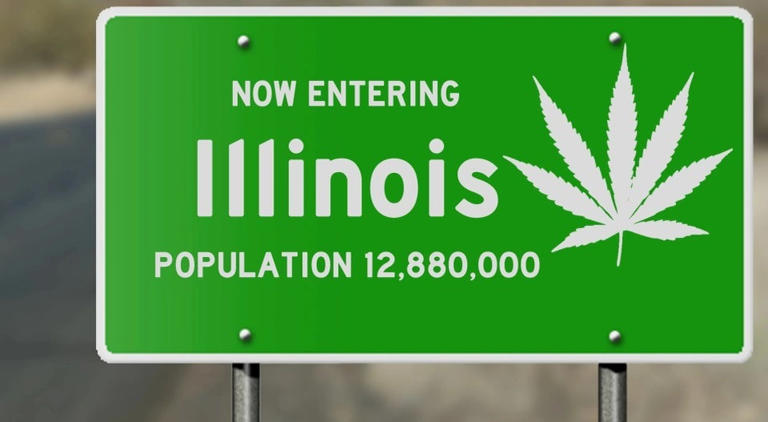









You must be logged in to post a comment.